

Our Offerings

We serve a diversified consumer base across the transportation, domestic, commercial and industrial segments. We operate through 17 of our authorized Geographical Areas, enabling balanced demand and revenue mix and benefits of scale. 

Our CNG consumers comprise private vehicle owners, commercial vehicle owners, taxis, auto-rickshaws, buses, two-wheelers, logistics fleets and municipal operators. Demand is supported by expanding CNG station density across urban centers, highways and transport corridors, and by structured engagement with fleet operators, cab aggregators and state transport undertakings.

Our PNG consumer base includes domestic, commercial and industrial consumers. Domestic PNG consumers primarily consist of households using natural gas for cooking and allied applications, supported by MDPE last-mile networks, charge-area based rollouts and simplified onboarding processes. The key advantage of using PNG includes safety (PNG is safer than LPG for households because it is lighter than air and disperses quickly in case of leaks, reducing the risk of accumulation, fire or explosion) and convenience, as PNG offers uninterrupted supply (without the need for booking or storage of cylinders), and ease of installation.

Commercial PNG consumers include hotels, restaurants, hospitals, educational institutions, retail establishments and other small businesses, where demand is driven by reliability of supply, convenience and predictable and lesser energy costs. Pricing and onboarding structures for commercial consumers are differentiated based on consumption profiles and pressure requirements.

Industrial PNG consumers comprise small, medium and large industrial units across sectors such as automotive, ceramics, metals, textiles, food processing and engineering. Consumers benefit from lower emissions leading to easier to meet sustainability targets, such as air quality norms. Industrial PNG also reduces handling and storage risks associated with solid fuels and serves as a uniform source of energy.


About CNG

CNG is promoted as an alternative transport fuel for passenger vehicles, commercial vehicles and public transport fleets to reduce emissions and dependence on conventional petroleum fuels. Key policy objectives include.

  • Reduction in vehicular emissions, contributing to improved urban air quality and lower greenhouse gas emissions.
  • Lower operating costs for high-mileage passenger vehicles, taxis, buses and commercial fleets.
  • Reduced dependence on imported crude oil and petroleum products, strengthening India’s energy security.
  • Expansion of CGD infrastructure, enabling wider availability of CNG across urban and semi-urban markets.
  • Facilitating the integration of renewable CBG into the transport fuel mix, supporting the transition towards lower-carbon mobility.

CNG Stations

CNG Station Locations

Station Name Address CNG Price
Inclusive of all Taxes
 

CNG Price


FAQ

Ans. CNG is Compressed Natural Gas, having the same properties as that of Natural Gas. The Auto ignition temperature of Natural Gas is 540 degrees Centigrade, which is far greater than its substitutes. The Lower Explosive limit and Higher explosive limits of 5% and 15% respectively are also substantially higher than Petrol, Diesel and Auto LPG. Due to the lower density of Natural Gas, it is lighter than Air and hence in case of leakage, it quickly disperses into Air. All these characteristics make Natural Gas a safe fuel compared to other alternative fuels available today.

Ans. CNG conversion is suitable for all petrol vehicles with carburettor, turbo, injection, and catalytic engines. CNG conversion is also possible for the most common direct injection engines.

Ans. CNG is the cleanest, greenest, and most economical fuel available today. CNG combustion does not produce carbon residues (which cause engine oil to turn black). For this reason, the engine oil in gas vehicles remains clear and its properties unaltered, even after many thousands of kilometers, which helps improve performance and reduce engine wear and tear.

Ans. Yes, using petrol as well as CNG is possible. In fact, today some car manufacturers have already launched models where this feature is factory-fitted. After installation of the CNG system, the petrol vehicle becomes Bi-fuel, in other words, it can run either on CNG or petrol. This increases the original economy of the vehicle, depending on the size of the gas tank installed.

Ans. CNG tanks are made from extremely resistant full steel to hold the final weight of the cylinder. They have extremely high mechanical resistance, tested to 300 bars, 1.4 times the normal working pressure, and are therefore extremely safe, approved and tested according to extremely stringent standards.

Ans. Using methane as a fuel reduces the emission of the greenhouse gas CO2 by over 20%. Emissions of CO and Nitrogen Oxides (NOx) are also significantly lower. HC emissions are also almost totally made up of pure, non-toxic methane. Gas cars do not produce particulate, in particular the PM10 that are critical for urban pollution.

Ans. In general, CNG cylinders suitable for 4-wheelers have a storage capacity of 9-10 Kg of CNG. Ideally, a CNG car can run around 180-230 kilometers with 9-10 Kg of CNG.

Ans. Yes, a diesel vehicle can be converted to run on CNG, but the conversion cost is higher than the conversion of petrol vehicles.

Ans. CNG is considered the least polluting fuel. As global warming is increasing at a tremendous rate, adoption of CNG can help mitigate this and create an environment with less pollution.

About Domestic PNG

Domestic PNG is promoted as a safe, reliable and convenient cooking fuel, providing households with continuous access to piped natural gas without dependence on LPG cylinder logistics. Key policy and consumer benefits include:
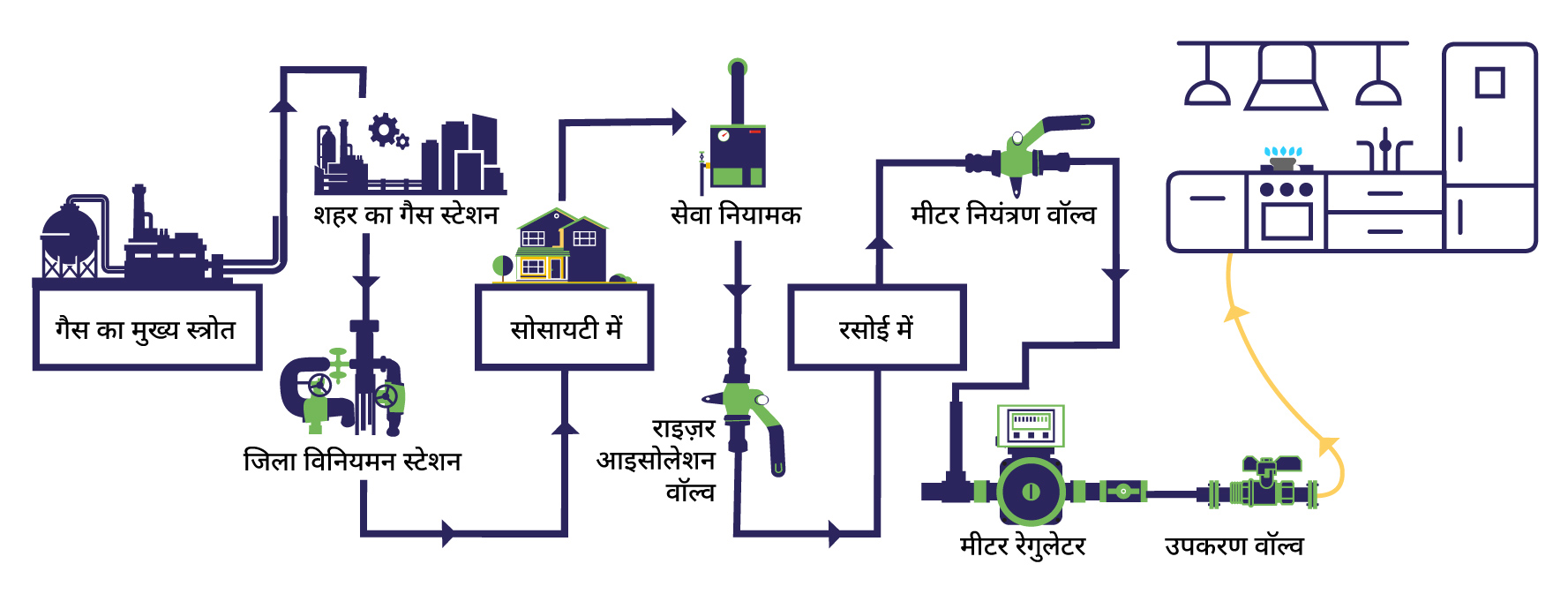
  • Continuous, metered fuel supply, eliminating the need for cylinder booking, storage and replacement while enabling consumption-based billing.
  • Reliable fuel availability during supply-chain disruptions or emergency situations, reducing dependence on physical cylinder distribution and ensuring continuity of household cooking requirements.
  • Improved household safety and convenience by eliminating cylinder handling, transportation and storage within residential premises.
  • Diversification of household energy sources, with PNG networks capable of supplying domestic natural gas, imported LNG and, over time, increasing volumes of renewable gases such as CBG.
  • Operational consistency through stable fuel quality and uninterrupted pipeline supply, supporting predictable cooking performance and enhanced consumer convenience.

Flow of Gas

Domestic Connection

Locations

PNG-Domestic Price


Technical Guidelines

Meter Positions

  • Gas Meters will normally be located inside the property on wall, and use of copper pipe between MCV and consumer meter should be restricted as far as possible. The Kitchen is the preferred room to locate the meter thereby minimizing the length of the outlet pipe - work.
  • The meter shall be installed in an area with adequate ventilation & Gas pipeline not to be concealed
  • As a guide, a minimum ventilation area of 2(degree)/o of the internal floor area of the room must be provided in the room where the meter is located. The gaps under and around doors, windows and ventilators provide adequate ventilation to the rooms of normally occupied individual domestic dwellings.
  • Space near Meter installation & pipeline should not be used for storage of any cleaning chemicals, harsh chemicals, rubbish or any other material prone to create any safety hazard to the meter/ pipeline and blocking ventilation.
  • Meters must not be installed along a route that is used by more than one property as a means of a fire escape-i.e., a communal fire escape route.
  • The meter shall be installed at a proper location and height, to facilitate safe and convenient meter reading and maintenance activities in future.
  • Appliance Valve shall be fitted at least 100 mm above the kitchen platform level and at an easily accessible location.
  • Steel reinforced rubber hose is connected between AV and Appliance Length of flexible hose shall be kept minimum.

Pipe work in Island type Kitchen

  • In some of the residences, kitchen platform is located in centre of the room and pipe work requires extending from MCV & meter (mounted on one of the wall) up to the appliance valve. Under such circumstances, pipe can be laid in flooring with adequate protection.
  • Pipe work passing through flooring should take the shortest practicable route and must be sleeved.
  • Pipe work laid in flooring shall be protected against corrosion, also against failure caused by movement. Pipes should be laid on the base concrete and avoid joints in the pipe section. A minimum of 65 mm screed is required on top of the concrete which will provide an approximate cover of 50 mm over a 12 mm installation pipe.

In case of screeded floors, the method of construction consists of a base concrete raft foundation onto which a cement screed is subsequently laid in order to obtain a satisfactory surface to accept the floor finish. In this case, copper pipes may be laid on top of the base concrete and subsequently covered by the screed, provided the pipe is protected from corrosion. Alternatively, the copper pipes may be laid through pre-formed PVC / HOPE sleeves / ducts with protective covers

Gas geysers Location: Gas Geysers should only be installed in areas like:

  • Kitchens, Living rooms, Utility Rooms, Halls and Passageways if flueing and ventilation can be achieved.
  • Gas Geyser should be installed at such a height that it can be switched off easily.
  • No Gas Geyser is permitted to be concealed Installation of Gas Geyser in Bathroom is not permitted

FAQ

Ans. PNG is mainly Methane - CH4 with a small percentage of other higher hydrocarbons. The ratio of Carbon to Hydrogen is least in Methane and hence it burns almost completely making it environment friendly. It is procured from the oil / gas wells and transported through a network of pipelines.

Ans.
Particulars Scheme - I Scheme - II
Interest Free Refundable Gas Consumption Security Deposit 500/- 500/-
Non-refundable Application Charges (without GST) 590/- 590/-
Interest Free Refundable Connection Security Deposit 6000/- N/A
Interest Free Refundable Connection Security Deposit in 12 instalments along with bimonthly bill N/A 557/-

Ans. "Security Deposit" means interest free refundable amount collected from the customer at the time of providing PNG connection towards the safe keeping of the equipment's installed at the premises of the customer.

Ans.
  • Every customer is required to furnish Security Deposit (SD) Rs. 500/- towards gas consumption at the time of Application form submission or during the year when such demand is raised by Torrent Gas. Torrent Gas will refund this Security Deposit amount at the time of permanent disconnection by the customer.
  • Failure to pay the Revised SD (Additional) will be considered as default and will be liable to disconnection.
  • Further when disconnection is done, charges for Disconnection and Reconnection shall apply prior to reconnection being provided to the customer.

Ans. Online payments using Credit/Debit cards to any mobile wallet is the most convenient way to pay your gas bill. You can also pay by arranging a standing instruction or bill pay facility thru your banks. Alternately, your DD/ Cheque must be made in favour of "Torrent Gas Limited" only. No payment should be made in cash. If the Payment is made towards the PNG connection, please write Name and Contact Number on the reverse side of the DD/cheque. If the Payment is made towards gas bills, please mention Name, Contact Number, Business Partner (BP) Number and Contract Account (CA) Number on the reverse side of the DD/cheque.

Ans. Send your request for permanent disconnection along with contact number in writing to our Customer Care and our representative will visit your premises and disconnect the line. Please ensure that all the previous dues are cleared at the time of disconnection. (Permanent disconnection charges will be applicable as per prevailing tariff card.)

Ans. Yes, the supply is absolutely regular. The pipeline distribution network is based on a positive gas pressure which is also looped for redundancy. Thus in normal condition, an un-interrupted supply at a constant pressure is assured.

Ans. Ideally the LPG cylinder needs to be surrendered so that the same can be used by the more needy of the society where PNG is unavailable. However, with LPG control order letter dated 09th January 2014 you can retain one LPG connection and the government oil companies shall provide the refill at the non-subsidized rate.

Ans. Your PNG consumption bill is generated BI Bi-Monthly. Billing is done on the Actual Meter Reading taken by our authorised meter readers once in 2 months as per the meter reading schedule. For further information please visit our Billing Section.

Ans. We would be glad to assist our valued customers and address any kind of queries with regards to PNG supply and services. For further information please visit our Customer Care section.

Ans. Presently, various gas-based appliances such as Gas Geysers, Air Conditioners and Generators are available in the Market. However, Gas geyser is being predominantly used in domestic segment in our operational areas. The other appliances such as Air Conditioners and Generators are being used mostly in commercial and industrial establishments.

Ans. Gas based geysers work by utilizing the energy from the combustion of natural gas, transferred directly from the flame to water. These systems are incredibly efficient at heating water. Torrent Gas aims to provide hot water in kitchen and bathroom as an economical and reliable solution for domestic customers. For further information please visit our Customer Care section.

Ans. Gas Generators for Residential buildings - Objective is to provide backup power solutions to residential societies during unavailability of grid power. Presently, Diesel Generators are used for backup power requirements which may be replaced with Gas generators.

Ans. Natural gas air conditioning is nothing new; in fact, it provided most of the air conditioning requirements in the 1940's and 50's. However, due to new advancements in technology and efficiency, natural gas air conditioning is experiencing resurgence in popularity. Modern residential Natural gas based air conditioners are more efficient, long lasting and low on maintenance.

Ans. Similar to the Pipe Gas System in Pune, Mumbai, A'bad, Delhi etc. the gas will flow through the Pipe Line continuously.

Ans. Torrent Gas will take a tapping from street main and bring the gas inside the society. We will install Service Regulator which will reduce the pressure to 100 mbar. This low-pressure gas will be transported to all the buildings using underground Polyethylene Pipe Line. Once Gas reaches the building it will be transported to all the flats using Galvanized Iron Pipes

Ans. The Pipe line will be installed on the side of the roads. In case it is paved using paver blocks, the same will be removed and placed back after Pipe installation. Most of the road crossings will be done using horizontal boring, and roads will not be damaged.

Ans. Yes

Ans. The entire installation will be done in accordance to Technical Specifications and Safety Standards(T4S) specified by Petroleum and Natural Gas Regulatory Board (PNGRB). It is very safe as demonstrated by working of over 40 lakh connections across the country.

Ans. Once the customer occupies the flat and opts for Natural Gas he will be billed for Gas as well as minimum fixed charges if any. Builder will be charged for gas consumption in common facilities such as canteen, sales office, club house etc.

Ans. Gas Meters are normally located inside the property on a suitable wall. A conspicuous place in the Kitchen is the preferred location for the meter as this minimises the length of the outlet pipe. It should be installed in a well ventilated and accessible area so as to facilitate meter reading and periodic maintenance.

About Industrial PNG

Industrial PNG supports fuel switching from coal, petcoke, furnace oil, LSHS and diesel to a cleaner gaseous fuel across multiple industrial sectors. Key benefits include:

  • Lower emissions of particulate matter, sulphur oxides, nitrogen oxides and carbon dioxide, supporting compliance with increasingly stringent environmental regulations.
  • Consistent calorific value and cleaner combustion, improving process stability, combustion efficiency and product quality.
  • Reduction in fuel storage, material handling and associated maintenance requirements, resulting in simplified plant operations.
  • Support for industrial decarbonisation initiatives, particularly across sectors such as ceramics, glass, chemicals, pharmaceuticals, food processing and textiles.
  • Enhanced operational reliability through uninterrupted pipeline-based fuel supply, reducing dependence on bulk liquid fuel procurement and storage logistics.

Application

  • Metal Melting
  • Heat Treatment
  • Pre-heating of ingots
  • Powder Coating
  • Moulding/ Casting
  • Fabrication
  • Gas Cutting
  • Smelting
  • Welding
  • Pyro processing
  • Forging
  • Steam Generation
  • Spray Drying
  • Baking of food products
  • Process Heating of food products
  • Drying of inks Pre-printing in textile
  • Pre Drying of inks Post-printing in textile
  • Waste Heat Treatment
  • Gas Genset for Power generation
  • Combined Cooling, Heating & Power for Power generation
  • Vapour Absorption Machine (VAM) for Air Conditioning
  • Centralized Cooling for Air Conditioning

FAQ

Ans. Torrent Gas understands the criticality of industries' operations and ensures that the supply of Natural Gas is 100% reliable. Natural Gas would reach your doorsteps through a reliable and safe underground pipeline network. Torrent Gas has taken adequate precaution to maintain integrity of underground pipeline network so that our industrial customers can get 24 x 7 un-interrupted supply of natural gas.

Ans. No, Torrent Gas does not supply burners nor install internal pipeline. However, our team of qualified and knowledgeable engineers can facilitate customers to select the right burners as well as to design the internal pipeline.

Ans. Due to characteristics of Natural Gas, it stands as the safest fossil fuel. As % LEL and %UEL limits are higher compared to LPG & Propane, auto ignition temperature is very high and low density hence in case of leakage natural gas immediately disperses in air. The Meter & Regulating Station (MRS) installed in your premise has an in-built safety system, which ensures tripping of regulator, in case of over pressure (choking) or under pressure (leakage).

Ans. Yes, Torrent Gas will have two types of contracts for industrial PNG connection.
  • MGO contract: in which fixed amount of quantity of natural gas needs to be consumed by the customer.
  • Non-MGO contract: in this contract, there is no obligation on the customer to consume natural gas. The billing would be done on the basis of consumed quantity of natural gas.
Hence for this type of industry, whose fuel consumption is irregular, it is advisable to go for Non-MGO contract to get industrial PNG connection.

Ans. For industrial PNG connections, billing frequency is fortnightly. Natural gas supply bill will be generated on 01st and 16th date of each month and the customer will be given 05 (five) business days from the date of billing for the payment.

Ans. The Price List for NG will be declared every fortnight at least seven days before the start of the fortnight and the same will be communicated through Electronic Mail, written communication, SMS and/or publish the same on Torrent Gas website.

Ans. As natural gas supply is un-interrupted and completely reliable, you may not need to keep the existing setup of the fuel. However, to deal with any unforeseen force major kind of situation, industries may keep the existing fuel setup as a fall-back option.

About Commercial PNG

Commercial PNG is promoted as a cleaner substitute for LPG and other liquid fuels across hotels, restaurants, hospitals, educational institutions, bakeries, laundries, malls and other commercial establishments. Its key advantages include:

  • Uninterrupted fuel availability, supporting continuous business operations without dependence on cylinder replenishment.
  • Elimination of LPG cylinder storage, handling and inventory management, improving operational efficiency and workplace safety.
  • Optimized utilization of commercial space by removing dedicated cylinder storage requirements.
  • Reduced logistics requirements and associated operational disruptions, particularly for establishments with high and continuous fuel consumption.
  • Consistent fuel quality and combustion characteristics, enabling precise temperature control, improved process efficiency and enhanced product quality in food processing and other heat-intensive commercial applications.

FAQ

Ans. To obtain commercial connection, please visit our website or get in touch with our Zonal Office or Call centre. We would be happy to meet you personally and offer you all required details.

Ans. As per guidelines, the following documents are to be submitted, duly self-attested:
  • PAN Card and GSTIN
  • Shop & Establishment License or Factory License or Institutional or School Establishment License, as applicable
  • Land Purchase Deed (if owned)/Agreement (if leased/Rented).
  • NOC from society/ landlord.
  • Identity Proof of signing authority (Driving License/ Election Card/Aadhar Card)

Ans. There is no requirement of statutory compliance or govt. approval to get commercial natural gas connection. Natural Gas is a clean and safe fuel hence Govt. promotes use of natural gas.

Ans. Torrent Gas will ensure in every possible way that natural gas supply is uninterrupted however due to any reason natural gas supply is interrupted due to any technical snag, our trained technical team would visit the site and restore natural gas supply at the earliest.

Ans. Technical team of Torrent Gas will inspect your existing pipeline in accordance with PNGRB T4S regulation and if the pipelines meets all necessary requirements then the same can be used for natural gas connection. In case, the pipeline does not meet some of the regulatory requirements then our technical team may suggest few points of improvement. Ideally, we would like to supply PNG only thru Torrent Gas approved & installed pipeline.

Ans. Yes, you can get Commercial connection on the rented/leased premise or land. However, you need to produce rent/lease agreement and NOC from the landlord to obtain natural gas connection.

Ans. Yes, you can transfer the ownership of the connection subjected to clearance of the all due payments to Torrent Gas and completion of the ownership transfer formalities with Torrent Gas.